ChatGPT
 Gemini
 Perplexity
 Claude
 Grok
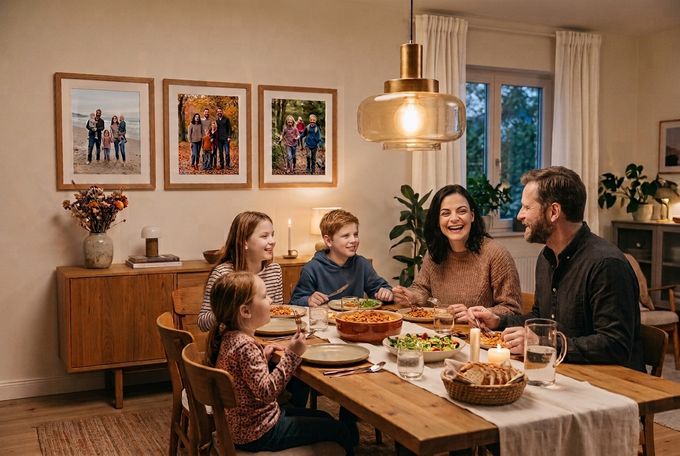
Your dining room does more than serve dinner. It's where stories get told, homework gets finished, and guests wander over to ask about the picture on the wall. The right dining room wall art gives all of that a warm backdrop instead of a crowded one, whether you host every weekend or only on holidays.
Below, you'll find eight dining room wall decor ideas for different room sizes and hosting styles, from a cozy nook to a grand formal room. You'll also get placement basics that keep art in view from every chair.
Why Your Dining Room Wall Sets the Mood
In a hallway, art gets a passing glance. In your dining room, it gets an audience. Everyone seated at the table faces the same wall for a whole meal, so along with color and lighting, it helps decide whether an evening feels rushed or relaxed.
Three things make this wall different from the rest of your home:
- A seated audience: Guests stay put and look around, so dining room art gets noticed and often becomes the first thing they ask about.
- A crowded room: The table, chairs, tableware, and lighting already compete, so art has to work with them, not against them.
- A table that does double duty: It may also be a homework spot or a makeshift office desk, so the wall should feel calm on a Tuesday afternoon too.
How to Hang Dining Room Wall Art
Hang art for the people sitting down, not the people walking past. Start with these three measurements for your dining room wall art, then test them from your chairs.
- Center height: Aim for about 57 inches from the floor to the center of the art. Dining rooms suit the lower end of the usual range, because everyone is seated.
- Gap above furniture: Leave 6 to 8 inches between a sideboard or console and the bottom of the frame, so the two read as one unit.
- Display width: Make the display about 70% as wide as the furniture beneath it, so it doesn't look lost on a wide wall.
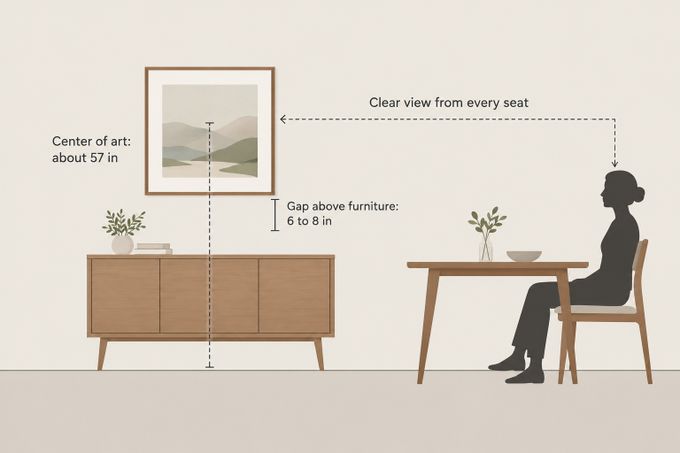
Once you've marked the wall, pull out a chair and run these checks:
- Sit at both ends: From the head and the foot of the table, make sure nothing blocks the view of the art.
- Look behind each chair: Leave enough room that no one leans back into a frame.
- Watch the light: Notice where the window and pendant fall, since reflections shift through the day.
8 Dining Room Wall Decor Ideas for Every Room Size
Each idea below covers who it suits, which frames to pick, which photos to use, and how to hang it. Mix and match whichever fits your space and home decor style.
1. A Matched Pair for Small or Busy Rooms
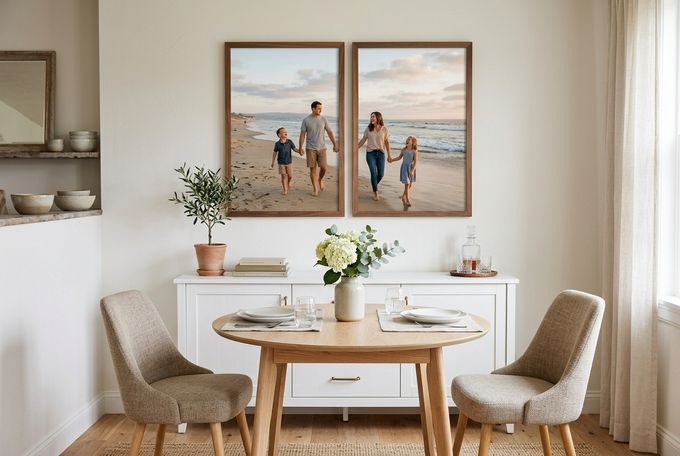
Two identical frames let the wall breathe. In a small dining room, or one already packed with pattern and tableware, a pair reads as one calm story instead of one more thing to look at.
Best For
Small dining rooms and rooms already full of pattern.
Frame Picks
Choose two frames of the same finish and size so they read as one piece. Black or white keeps the look classic. With a pale oak table, consider contrasting the frames instead of matching them with deeper walnut for warmth.
Photos That Work
- Twin portraits: Two close-ups of the same child, shot in similar light, read as a matched set.
- One scene, two frames: Split a single wide photo, like a family day at the beach, across both frames.
- Day and night: Pair the same scene in daylight and at dusk for a quiet contrast.
How to Arrange It
- Match the scale: Aim for a combined width of about 70% of the furniture beneath. Above a 60-inch sideboard, that's roughly 42 inches for the pair, gap included.
- Keep the gap tight: Leave 2 to 4 inches between frames, and center the pair over the furniture.
- Leave room below: Keep space for flowers or ornaments so nothing touches the frames.
2. A Square Grid Above the Sideboard
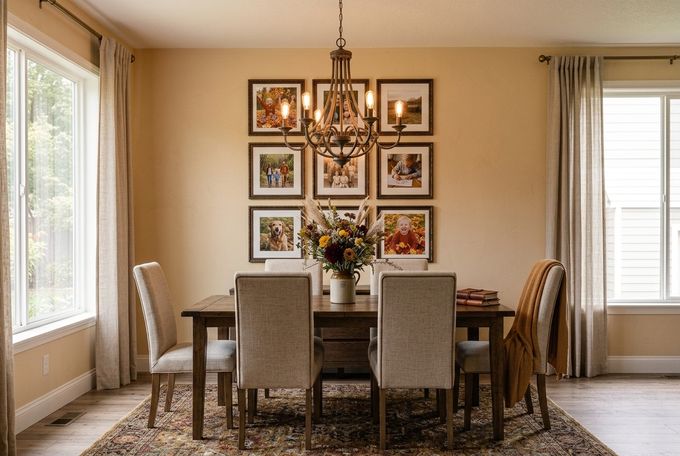
A 9-square grid gives your wall structure and a tidy, intentional look. Because the frames repeat, it also becomes a living display. Keep most of them as year-round family portraits, then change two or three with the seasons, like a photo of the kids in autumn leaves for fall. The wall stays anchored while still reflecting what your family is up to right now.
Best For
Hosts who like a structured look with a little seasonal change.
Frame Picks
Keep one finish across the grid so the frames read as one unit. Black or white frames look crisp and graphic, while oak or maple feels softer. Use one frame size and one mat treatment across the grid, so any seasonal photo can drop into any spot without changing the look.
Photos That Work
- Year-round anchors: Most frames hold portraits that stay put, like close-ups of the kids or relaxed family candids.
- Seasonal swaps: Change two or three frames for each season, such as the kids in autumn leaves or on a winter hike.
- Occasion swaps: Add a birthday or holiday gathering shot when one is coming up.
How to Arrange It
- Set the rhythm: Keep the gaps even and tight, at about 2 inches.
- Hang low: Leave 6 to 8 inches above the sideboard.
- Choose your swap spots: Pick two or three frames to rotate, such as opposite corners, so the grid stays balanced while it changes.
- Refresh with the seasons: Change them up to four times a year, so the wall always reflects your family's latest moments.
3. A Heritage Wall With a Modern Edge
A heritage wall shows off your family across generations, and how you hang it decides whether it feels stuffy or fresh. Taking a more modern approach makes the wall feel like a collected family story instead of a formal portrait display.
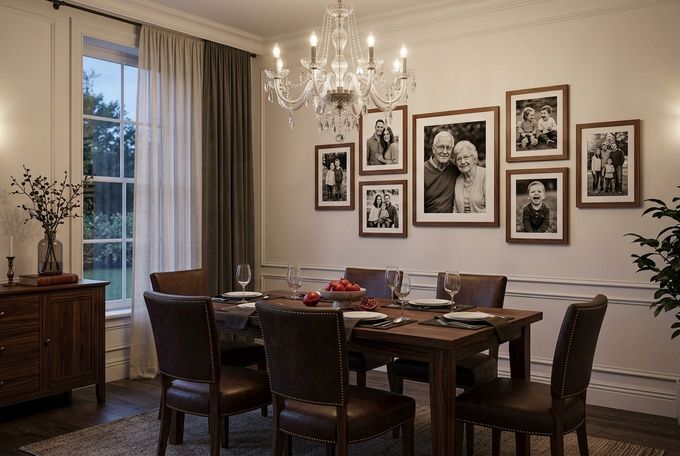
Three design choices give it a contemporary edge:
- Matching frames: One style and finish ties together portraits from different decades.
- An off-center layout: Skipping perfect symmetry makes the wall feel relaxed and open.
- A limited count: Stopping at about seven pieces reads as curated, not like a full gallery wall.
Best For
Dining rooms that pair contemporary furniture with a love of family history.
Frame Picks
Match your frames, not your photos. Walnut or black gives a rich, gallery-like feel, and mixing different frame sizes adds rhythm. If you add mats, use the same mat color on every piece so the group stays cohesive.
Photos That Work
- Grandparent portraits: Formal studio shots in black and white set the cross-generational tone.
- Wedding portraits: Hang a couple from each generation side by side.
- A modern portrait: Add a recent family photo restyled with Photo to Art, which turns a photo into a painting or sketch. An oil painting style sits comfortably beside older pieces.
How to Arrange It
- Start in the middle: Hang your largest portrait near the center.
- Build outward: Add smaller frames in horizontal and vertical rows, mixing sizes, and let the outline stay a little uneven.
- Link it to the table: Contemporary chairs, such as dark leather, and a statement chandelier connect the portraits to the room.
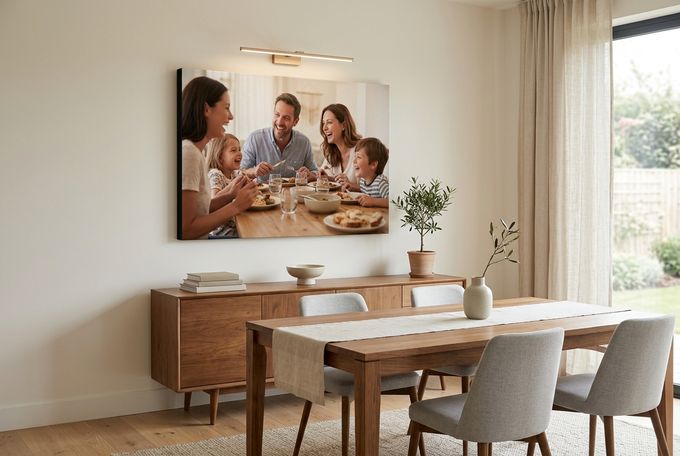
4. One Oversized Wrapped Canvas as the Statement
A single large piece makes a confident conversation starter. The minimalist layout creates calm, since the eye has just one place to land, while anchoring the room at the same time. The key is scale and color: choose a piece big enough to lead, with tones that work with your table and walls so it doesn't dominate.
Best For
Rooms with a wide, open wall.
Frame Picks
A wrapped canvas, where the print continues around the edges with no outer frame, suits this idea well because nothing competes with the image. If you prefer a defined border, a framed canvas in oak or walnut echoes your table's wood and ties the piece to the room.
Photos That Work
- A big family laugh: A wide, candid shot of everyone around the table holds up at scale.
- Bold, simple compositions: Strong shapes and a clear subject read well from across the room.
- Landscapes with a story: A favorite trip or a place your family returns to.
How to Arrange It
- Center it: Hang the canvas centered above the sideboard or table.
- Get the height right: Keep the center near eye level and the bottom edge 6 to 8 inches above any furniture beneath it
- Keep fixtures clear: Make sure a pendant doesn't hang low enough to block it.
- Add a picture light: A slim fixture adds emphasis without taking up visual space.
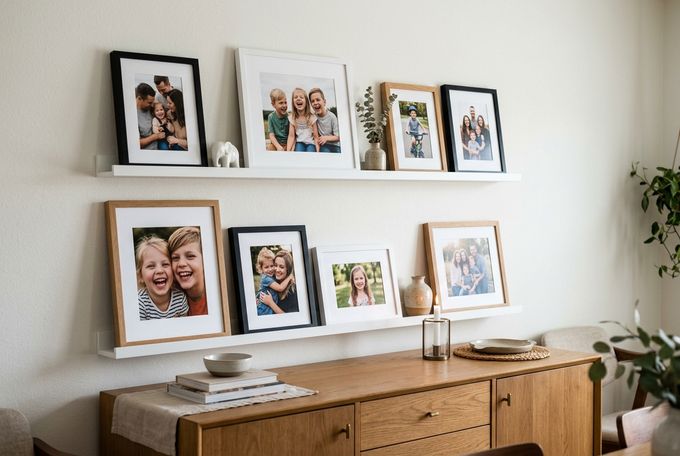
5. Two Picture Ledge Rows Above a Console
Two long ledges let you layer frames and lean them, which gives the wall a relaxed, slightly eclectic look. It suits dining rooms where the photos change as often as the guest list.
Best For
Anyone who wants flexibility. A ledge keeps your options open, so you can add, swap, and re-layer pieces without making new holes.
Frame Picks
Mix black, white, and different wood tones for frames, and vary the sizes for interest. Different heights and orientations give the rows a layered, collected look.
Photos That Work
- Candid family moments: Kids mid-laugh and holiday chaos add life to the rows.
- Travel photographs: Favorite trips sit well beside everyday scenes.
- Quiet landscapes or botanicals: A calmer image rests the eye between busier frames.
How to Arrange It
- Center the rows: Keep both ledges centered on the console and within its width.
- Layer by size: Start with the largest frames, then fill gaps with smaller ones, overlapping slightly.
- Check the depth: Choose ledges deep enough to hold your frames securely, since solid wood frames have some depth.
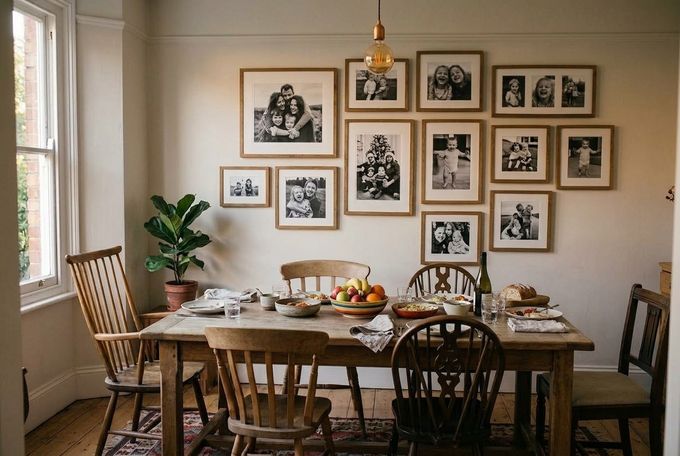
6. A Relaxed Gallery Wall With a Harmonized Palette
An irregular gallery wall mixes frames of different sizes in a loose layout instead of a strict grid. That variety keeps the eye moving and gives guests plenty to point out. The secret is a harmonized palette. When your photos and frames share a color story, the wall feels collected and calm instead of chaotic.
Best For
Relaxed, lived-in family dining rooms where the table sees plenty of everyday life.
Frame Picks
Limit the frames to one finish, and mix the sizes for energy. White mats help photos with different backgrounds sit comfortably together.
Photos That Work
- Golden-hour glow: Gather shots taken in warm evening light, like the kids on the beach at sunset or a candlelit birthday dinner.
- Black-and-white conversions: Turn a few colorful snapshots into black and white, so very different scenes read as a set.
- One repeating color: Pick a thread, such as blue in a swimming pool, a denim jacket, and a summer sky.
- Close-up details: Mix in small moments, like little hands kneading dough or a grandparent's hands passing a dish.
How to Arrange It
- Lay it out first: Arrange the frames on the floor, or tape paper templates to the wall, and adjust before you drill.
- Start with the largest: Place your anchor frame slightly off-center, then build around it.
- Alternate orientations: Place portrait and landscape frames side by side, so same-sized frames don't line up in a row.
- Keep gaps close but not equal: Aim for 2 to 4 inches between frames, varying a little so the wall feels lived-in.
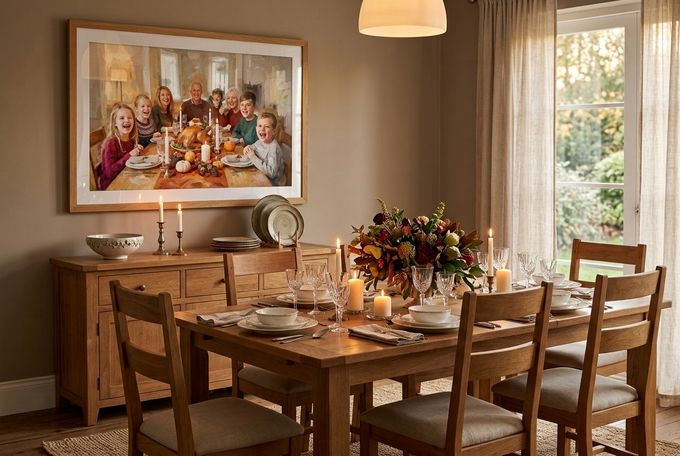
7. A Photo to Art Focal Piece
Turn a favorite gathering, like a holiday dinner or a birthday table, into a painterly piece that anchors the room. Photo to Art restyles your photo in an artistic treatment, from more minimalist pencil and sketch designs to watercolor and brush-oil painting effects.
Best For
People with an eye for art who want a favorite moment to look like a painting, not a snapshot. They also enjoy a touch of drama or whimsy at the table.
Frame Picks
Let the art style guide the frame. Soft, light styles like watercolor look airy in maple or white, which keep the focus on the image. Richer styles like oil painting suit walnut or black, which add depth the way a gallery frame does.
Photos That Work
- A full table: A holiday meal seen from one end, with candles and faces lit by warm light, makes a rich scene once restyled.
- Two generations at work: A grandparent and grandchild rolling out dough or setting the table together tells a story at a glance.
- A clear subject: Choose photos with one focal point and an uncluttered background, since busy details can lose definition once restyled.
How to Arrange It
- Center it: Hang it above the sideboard, or on the wall at the head of the table.
- Match the shape to the wall: Choose a wide landscape piece for a wide wall, or a square for a smaller one.
- Give it breathing room: Leave generous blank wall on each side, so the piece reads as the focal point, and nothing competes with it.
8. A Tall Triptych for High-Ceilinged Rooms
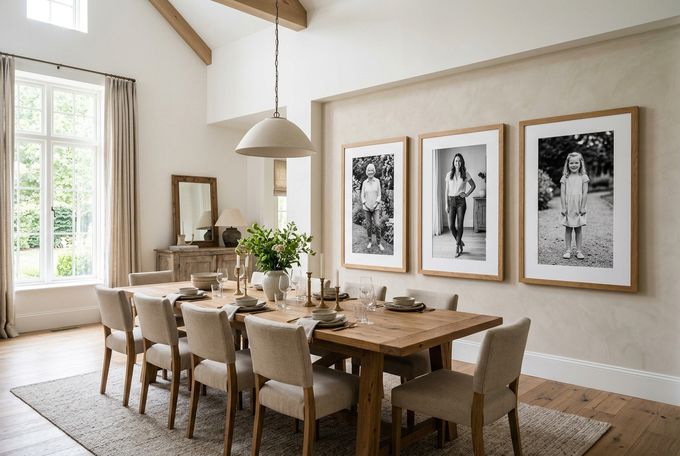
Three identical tall frames in a row draw the eye up and give a large wall real presence. This idea needs ceiling height and a generous wall, so skip it in a small room where it can overwhelm. In the right space, a matched trio feels cohesive and puts the art center stage.
Best For
High ceilings and wide, uninterrupted walls.
Frame Picks
Oak or walnut suits large frames well, since the grain adds warmth at scale. A wide mat adds breathing room around each photo and keeps the trio from feeling heavy.
Photos That Work
- Three generations: One portrait each of a grandparent, a parent, and a child.
- One day in three frames: Morning, afternoon, and evening at a family gathering.
- One child, three ages: The same pose and light, years apart.
How to Arrange It
- Size the group to the furniture: Aim for the trio's total width, gaps included, to span about 70% of the table or sideboard below.
- Match exactly: Use the same finish and mat on all three, centered on the table rather than the pendant.
- Mind the height: Leave 6 to 8 inches between the bottom of the frame and the sideboard or console. On an open wall, center the group near 57 inches.
Lighting, Materials, and Sound That Support Your Art
Your wall isn't working alone. A few other elements determine whether your wall styling choice feels cohesive or competes with everything around it.
- Busy fixture, simple art: If your chandelier is ornate, choose a simpler arrangement, and vice versa, so only one element leads.
- Layered warm light: Choose warm-toned bulbs and skip harsh, bright white ones, which flatten the mood. Small battery-powered LED lights on the table add pools of glow.
- Softer sound: A rug, drapes, and upholstered chairs absorb echo, so conversation carries more comfortably around the table.
- Protected art: Keep art out of direct sun and splash zones. A protective acrylic overlay can also help shield prints from dust and splashes.
Build a Dining Room Wall Worth Gathering Around
The best wall art for dining room spaces starts at your seat. Check the view from every chair, size the display to the furniture beneath it, and let warm lighting and repeated materials support the look. Then choose the layout that fits your room, and fill it with photos that tell your family's story, so every meal has something worth talking about.
FrameForest's solid wood picture frames come in oak, maple, walnut, black, and white. Our wrapped canvas suits one big statement, and photo to art turns a favorite moment into painterly dining room artwork. The most important thing is to make your wall design feel uniquely yours.
FAQs
How high should you hang dining room wall art?
Aim for about 57 inches from the floor to the center of the art. Dining rooms suit the lower end of the usual range because you're usually seated. Measure to the center rather than the top, so tall and small pieces share the same eye line.
What size art works above a dining room sideboard?
Aim for a display about 70% as wide as the sideboard, with 6 to 8 inches between the furniture and the bottom of the art. Above a 60-inch sideboard, that's a display roughly 42 inches wide. A pair, a grid, or two ledge rows all work within that width.
What frame color suits a wood dining table?
Contrast usually works better than a match. With a pale oak table, walnut, black, or white frames add warmth and definition. A dark walnut table pairs well with lighter oak, maple, or white frames.
Can you hang art near a window or serving area?
Yes, with a little planning. Keep art out of direct sun, which can fade prints over time, and away from spots where food splashes or steam are likely. An acrylic overlay can add protection from dust and splashes.
How do you refresh wall art for dining room spaces through the seasons?
Swap just one or two frames and keep the rest, such as a summer pool scene in July and a ski or hiking shot in winter. You can also rotate in a birthday, holiday, or anniversary photo when the event is near. Changing the table linens, napkins, and centerpieces shifts the mood quickly while the wall stays steady.
Is it okay to hang art in a dining room that doubles as a home office?
Yes, as long as the art works for both roles. Choose calm images you'd be happy to have behind you on a video call, such as a soft family portrait or a quiet landscape. Light frame finishes keep the wall looking uncluttered during the workday.